If you were watching the markets last night, you probably felt the chill—the Dow plunged more than 500 points right after the Federal Reserve wrapped up its meeting. On the surface, this meeting “did nothing”: rates were left untouched at 3.50%–3.75%. Yet the market responded with a sharp sell-off, and that reaction is itself a telling signal.
At the heart of it was the first meeting chaired by new Fed Chair Kevin Warsh, which turned out to be more hawkish than markets had expected. Not because rates were raised, but because Fed officials collectively pivoted their outlook toward a much tighter stance.
For ordinary investors like us, the real concern is never “will they hike this time,” but rather “the market’s original script has been rewritten.” When the dream of rate cuts is officially put on pause, short-term market risk really does rise. In this article, I want to break down—in the plainest language possible—what happened, why the market is afraid, and the traps retail investors most easily fall into, along with the right posture to hold.
Signal 1: The Fed Is More Hawkish Than Expected, and the Script Got Rewritten
First, the most important point: the rate hold was no surprise. Before the meeting, CME FedWatch already showed roughly a 97% chance of no change, so “no action” was not news at all (Stock Titan).
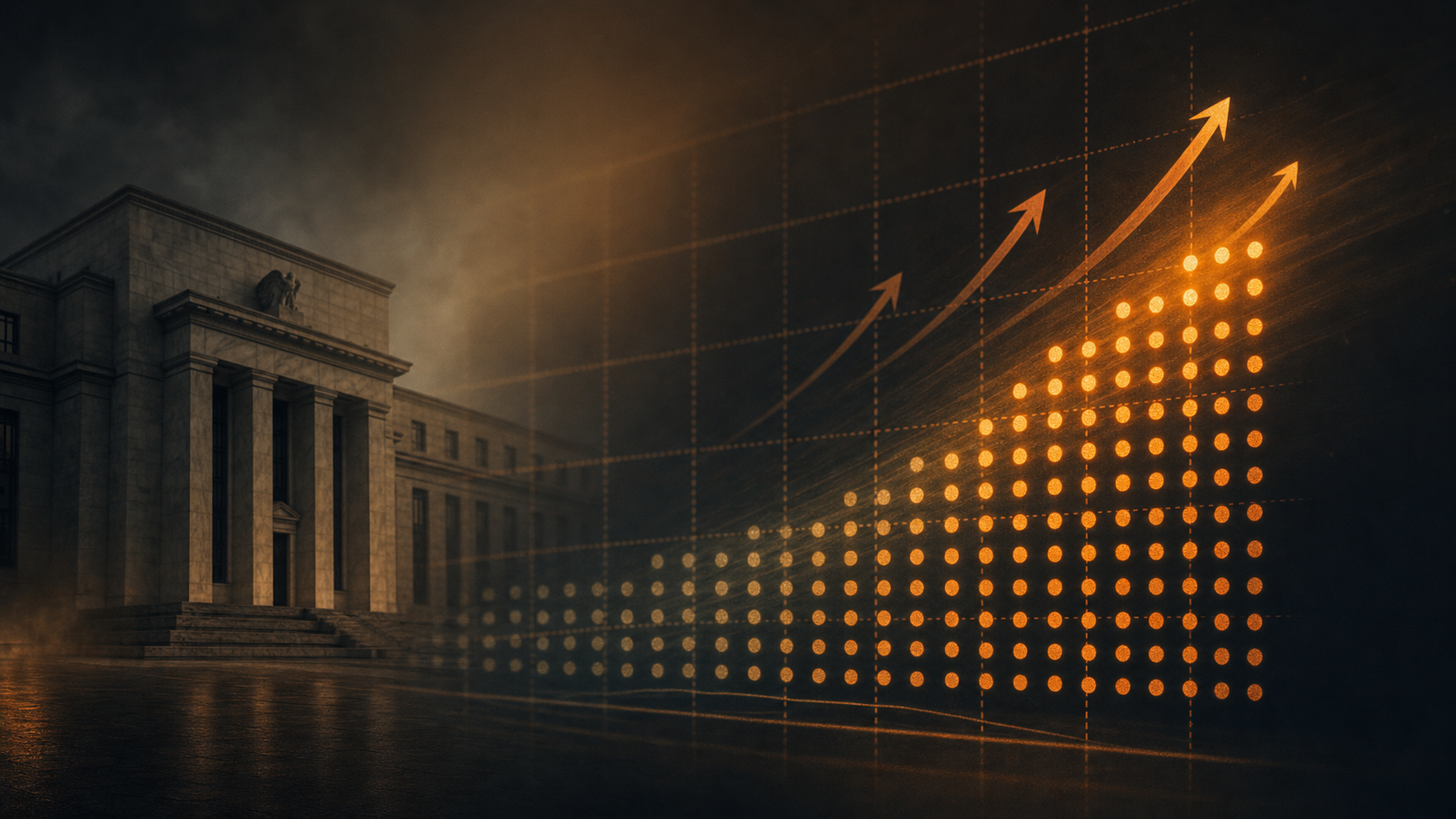
The real shock was hidden in the “dot plot,” which records each official’s forecast for future rates. In March, the median still projected one rate cut by the end of 2026; this time, the median jumped straight from 3.4% to 3.8%—flipping from expecting a cut to expecting a hike (CNBC). Of the 18 officials who submitted forecasts, 9 saw at least one hike this year, and 17 saw inflation risks tilted to the upside (Stock Titan).
Going further, the Fed sharply raised its core PCE inflation forecast for this year from March’s 2.7% to 3.3%, well above the 2% target (Benzinga). At the same time, the post-meeting statement removed language hinting at “possible future cuts,” and Warsh stated outright that he would abandon forward guidance (Moneycontrol). In one sentence: the Fed’s policy tone has officially shifted from “the next move is more likely a cut” to “Higher for Longer.”
Signal 2: Why the Market Sold Off Right in Front of You
Once you understand the rewritten script, the market’s direct reaction makes sense. This was a textbook hawkish response.
The bond market moved first. The 2-year Treasury yield, most sensitive to policy, jumped about 8 basis points to 4.13% immediately after the decision, as traders quickly pulled their bets on cuts (Benzinga). Futures-market odds of a hike before year-end surged from about 24% a month ago to roughly 77% (Stock Titan).
Stocks expressed themselves through declines, with the Dow plunging more than 500 points at one point (Yahoo Finance Taiwan). The logic is simple: interest rates are the “gravity” of assets, and when rate expectations rise, the valuations of all risk assets get pushed down—especially tech and growth stocks whose high price-to-earnings ratios rest on imagined future profits. Even big institutions like UBS and Goldman Sachs pushed their rate-cut expectations out to 2027 (Capital Futures).
But let me help calibrate one key point here: this drop was a “repricing of expectations,” not a breakdown in the financial system. Understanding it as the market digesting a worse script—rather than the end of the world—gets you closer to the truth.
Signal 3: The 3 Mistakes Retail Investors Most Easily Make Right Now
Every time the market shakes, what truly causes retail investors to lose money is often not the market itself, but their own emotional reactions. At times like these, watch out for these three traps in particular.

First, panic-selling at the very bottom. Seeing a sea of green (the color of declines in Taiwan stocks) and rushing to liquidate everything is the most common loss-aversion response. But hawkish-driven declines are mostly “valuation corrections” rather than “fundamental collapses,” and selling at peak emotion often means selling right before the rebound.
Second, rushing to “average down” at the bottom. The opposite extreme is seeing a drop, assuming it’s cheap, and piling in mindlessly. But when the Fed clearly says “higher for longer,” the pressure may last more than a day or two; firing all your ammunition at once leaves you no flexibility for the volatility that follows.
Third, betting heavily on one direction after reading a single headline. A hawkish pivot doesn’t mean it’s all downhill—many institutions believe this hawkish dot plot was inflated by the hawkish stance of regional Fed presidents, and the hikes may not actually happen (U.S. News). You can have a view, but betting your entire net worth on one script turns investing into gambling. Ultimately, in the short run the market is a voting machine that weighs emotion; only in the long run is it a weighing machine that measures value.
How to Stand Firm in a “Higher for Longer” World
After all this talk of risk, the point isn’t to scare you into paralysis, but to have you face it with the right posture. Heightened short-term risk is precisely the moment to test your own investment discipline.

First, return to asset allocation rather than guessing direction. No one can accurately predict the Fed’s next move, but what you can control is your own position structure. In a high-rate environment, the appeal of cash and short-term bonds rises; appropriately boosting defensive positions and diversifying well matters far more than betting correctly on a single trend.
Second, keep your emergency fund and your ammunition ready. When volatility expands, only those with cash on hand stay composed. Make sure your living reserve is sufficient and deploy your investable spare cash in batches, so you’re never forced to sell stocks for cash at the worst possible time.
Third, lengthen your time horizon. The Fed itself still expects the long-run neutral rate to be around 3.1%, meaning “higher for longer” is a process, not a permanent state (Stock Titan). For long-term investors, rather than reacting to every ripple in the dot plot, it’s better to confirm the quality of your holdings, keep dollar-cost averaging, and let compounding and discipline work for you.
Back to the question we started with: Warsh is more hawkish than expected, and short-term market risk really has risen. But rising risk never means you should flee—it’s the market screening for who is a gut-feel gambler and who is a systematic investor. True wealth awakening isn’t predicting every tremor correctly; it’s being prepared before the tremor arrives.
If this was helpful, feel free to save it on Aciemind and share it with friends who are also watching the markets. In the next article, I’ll dig into concrete asset allocation strategies for a high-rate environment.
Disclaimer: This article is a sharing of macroeconomic and market observations only. The data and institutional views cited are drawn from publicly available information and do not constitute any investment advice or buy/sell recommendation. Investing involves risk and markets change rapidly; readers should evaluate independently and take responsibility for their own investment decisions.
Comments