
On one side is a factory owner — over 100 employees, three shifts running 24/7, machines never stopping — yet after settling the books at year-end, barely NT$200K in hand. On the other side is Old Chen, sitting in a cafe, no factory, no products, not even a single full-time employee. He drinks tea, chats, makes phone calls, and in three months he’s earned NT$600K.
This isn’t a motivational fairy tale — it’s one of the most real and brutal lessons in the business world. The gap doesn’t come from luck or background, but four words: resource integration.
Today we’ll dissect this case like surgery, layer by layer, to see where those invisible profits are really hiding.
Layer 1: Discovering a Market Where Everyone Is Wasting Money
Old Chen had been around the Wenzhou business circle for years. He noticed a phenomenon most people ignored: thousands of small and medium enterprise owners in Wenzhou were willingly wasting money every year on one thing — internal corporate training.
He didn’t rush to sell anything. Instead, he spent two weeks meeting over 30 SME owners for tea. In the teahouse, after the atmosphere settled, he’d toss out one question: “Boss Wang, Boss Li, how much did your companies spend on training last year? How were the results?”
This question was like a stone tossed into a still lake, instantly creating ripples.
Wang, who ran a garment export business, slammed down his teacup: “Spent 50K on some so-called management guru from Shanghai. Flashy PowerPoints, theories galore. Workers were pumped during the session, but by the next day everything went right back to normal. 50K down the drain without a splash.”
Li, who made valve components, chimed in: “I had it worse. Had my admin cobble together courses from the internet. Employees sat there playing on their phones and dozing off. Money wasted, time wasted, and they even complained about it cutting into their off-hours.”
The pain points were remarkably consistent:
- Demand is rigid — companies need growth, teams need development, training can’t stop
- Supply is chaotic — trainers are a mixed bag: either ivory-tower theorists or street hustlers with inflated prices
- Results are uncontrollable — big money spent with no way to measure outcomes, turning it into a muddled account
Old Chen’s first move wasn’t to create demand, but to discover and validate a widespread “inefficient market.” The essence of business opportunity isn’t how great your product is — it’s that there exists a pain point urgently waiting to be solved. These ineffective training expenses of 40-50K per year? That was the most fertile business soil.

Layer 2: Trading “Certainty” for Price Discounts
After hearing the bosses’ complaints, Old Chen had his answer. He turned to meet another group — those scattered among the public, genuine corporate management consultants with real expertise.
Many were former senior executives from major corporations — strategic thinkers, marketing experts, people management masters — carrying real, gold-standard knowledge. But they had one fatal weakness: extremely poor client acquisition skills. They were top-tier product managers but unqualified salespeople. Like master swordsmen with dragon-slaying techniques who couldn’t find where the dragon’s cave was.
Old Chen found several reputable consultants and delivered a pitch that hit the bullseye:
“Mr. Zhang, your professional expertise is a scarce commodity in the market, but the time you spend finding clients is a massive waste. I have over 30 hungry Wenzhou companies — clear needs, strong paying ability. From today, you don’t need to worry about anything. All front-end business coordination, negotiation, and contracts are my responsibility. You only need to do one thing — deliver your courses and expertise to the fullest.”
One condition: settle at 60% of market rate. For example, if a day’s session goes for 40K on the market, Old Chen’s settlement price would be 24K.
Mr. Zhang’s mental abacus clicked immediately. A market rate of 40K per session sounds great — but that’s the ideal scenario. To close one deal, you’d need to court three to five potential clients, factoring in time costs, travel costs, and entertainment costs. The actual profit isn’t that high. And closings are random, with extremely unstable income.
Now Old Chen’s offer: the per-session fee is 40% lower, but it frees up all the time spent finding clients. More importantly — a stable, continuous flow of sessions.
Old Chen saw through a fundamental truth about human nature: for top professionals, the deepest desire isn’t maximizing one-time earnings, but certainty about future income. Uncertainty breeds anxiety; sustained certainty brings security and dignity. He used client resources to provide a scarce sense of security. In exchange, the other party willingly surrendered profit margin.
This was an unequal but mutually perceived “absolutely fair” trade.

Layer 3: Integrating “Sunk Assets” to Become an Irreplaceable Value Hub
If Old Chen had simply matched consultants with companies, he’d be at most an information broker earning referral fees — maybe 60K in three months, but definitely not 600K.
What truly widened the gap was his third move: integrating venue resources to make himself an irreplaceable value hub.
He found managers at several high-end business clubs in Wenzhou and proposed a deal they almost couldn’t refuse:
“Manager Wang, your training rooms sit empty weekday mornings through afternoons. I guarantee at least ten corporate training sessions per month, all held at your venue. You give me the space for free. In return, all tea breaks, fruit, lunch catering during training sessions are provided and charged by you. All parking, dining, and extra consumption revenue goes entirely to you.”
Manager Wang did the quick math: the space sits idle anyway — electricity and AC costs are already running. Now someone’s bringing free foot traffic — 30-40 people per training session. Tea breaks and simple meals alone are significant revenue, not to mention the potential to convert these premium clients into future members. All upside, no downside. Deal signed on the spot.
Now look at the cards in Old Chen’s hand:
| Resource | Acquisition Cost | Market Value |
|---|---|---|
| Top-tier consultants | 60% of market rate | Very high |
| Premium training venues | Zero | Thousands per day |
| Tea break catering service | Zero (club bears the cost) | Included in package |
He took these three things — none of which belonged to him — and carefully packaged them into an entirely new product: a one-stop corporate training solution.
Then he went back to those sighing bosses with a simple, direct pitch: “The consultants are hand-picked practitioners I’ve screened from dozens. The venue is the finest business club in the city center. Even the tea breaks and refreshments are arranged. You don’t need to worry about a thing — just get your employees there on time. Package price: 28K — at least 30% cheaper than finding a consultant yourself.”
Save money, save hassle, save face. This choice had no second option.

Profit Breakdown: Zero Capital, Pure Cognitive Leverage
Let’s do the math:
| Item | Amount |
|---|---|
| Consultant settlement (60%) | NT$24K |
| Client package price (70%) | NT$28K |
| Venue cost | 0 |
| Profit per session | NT$4,000+ |
| High-ticket course profit | Up to NT$9,000 |
| Sessions in 3 months | 70+ |
| 3-month net profit | Over NT$600K |
Some might ask: isn’t this just being a glorified middleman?
No. An ordinary middleman does information relay, earning from information asymmetry — a value that diminishes as information becomes transparent. What Old Chen did was value restructuring — he took the consultant’s idle expertise (A), the club’s idle venue time (B), and the companies’ unmet training needs ©, and through himself as the “central processor,” deeply integrated, optimized, and packaged them into a new value entity where A+B+C far exceeds simple addition.
He wasn’t earning a spread — he was designing transaction structures.
And he planted a long-term play: after each training session he’d create a WeChat group. In three months he’d accumulated 3,000+ mid-to-senior corporate managers — people with clear professional identities, strong learning motivation, and verified paying ability. The long-term value of this precision private traffic pool likely far exceeds the NT$600K in cash.

Same Logic, Different Skin: The Building Materials Pipeline Model
If Old Chen’s case seems too “elegant,” here’s a more bare-knuckle version.
A young man named Xiao Zhang in Wenzhou made over NT$300K per month in the building materials business — without opening a factory or storefront. His model had just two ends:
Demand side — find young homeowners who just got their keys but know nothing about building materials. He positioned himself as a “renovation butler”: “From design style guidance to all tile, flooring, bathroom, and cabinet purchases, to contractor coordination — I handle everything for you. Zero service fee. The only requirement: all materials come from my partner suppliers.”
Supply side — find source factories or tier-one distributors: “I bring at least 30 precise customers per month. High volume, stable, no accounts receivable delays. Give me 12% channel rebate on each order.”
The key brilliance: the wool doesn’t come from the sheep’s back. All of Xiao Zhang’s partners were source factories, getting wholesale prices naturally 25% below retail. Say a tile retails at 100, factory price is 75, he recommends it to homeowners at 87:
- Homeowner: pays 87 for something that sells for 100 in stores, saves 13%, plus gets a free butler
- Factory: sells a product costing 60 to make at 87, gets stable bulk orders
- Xiao Zhang: takes 12% rebate from 87 ≈ 10.4, zero inventory, zero risk
A single household’s total renovation materials run about NT$500K — he gets NT$60K in rebates. Serving 60 households simultaneously, monthly revenue exceeds NT$300K.
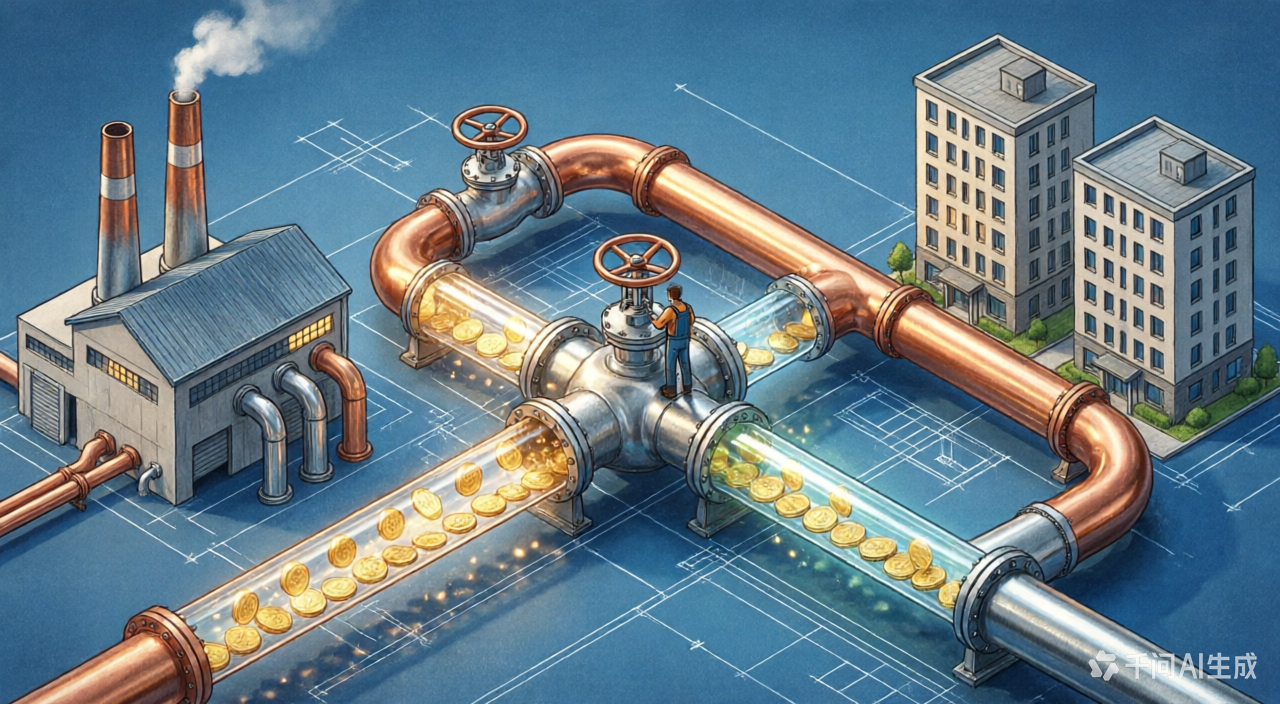
This isn’t a company — it’s an automated profit pipeline. Traditional business runs on buy-sell logic — buy low, sell high, bear inventory risk. Xiao Zhang’s model runs on pipeline logic — occupying the critical nodes of information flow and capital flow, letting profit flow like water through the pipes he’s built.
Are You Laying Bricks or Drawing Blueprints?
These two cases differ in model and industry, but their core is identical: neither had their own products, factories, or employees, yet earned far more — and far more easily — than those grinding in the red ocean.
Because they weren’t playing the product game — they were operating on a higher dimension: the cognitive game.
The ordinary person’s approach to making money is always: What do I have? What can I do? What can I sell? — this is “producer thinking,” where income is directly tied to labor hours, with a visible ceiling.
But these business masters think: What does the market lack? Who owns those things? Who urgently needs them? How can I design a transaction structure that perfectly connects them so every party benefits? — this is “connector thinking,” or the value architect mindset.
Imagine you need to lift a 100-pound stone. Some people use their bare hands, exerting 100 pounds of force — that’s linear effort. Others spend 20 pounds of effort finding a long enough lever and a fulcrum, then use the remaining 80 pounds to move 1,000 pounds or more.
That lever that moves the thousand-pound boulder is your ability to integrate resources. Other people’s products, traffic, capital, time, needs — all of these can become your leverage.
The greatest fairness of this era is that information is increasingly transparent — everyone has the chance to find their own lever. The greatest unfairness is that some people understand this and act immediately, some understand but hesitate and watch, and most still don’t understand — still believing that the only way to make money is to bear that boulder with their bare flesh.
The most expensive thing in this world was never money or time — it’s your cognition. When cognition stays at the one-dimensional level of “sell products, compete on price,” every cent is hard-earned. When cognition rises to the three-dimensional level of “build platforms, allocate resources, set rules,” making money stops being a grueling process and becomes the natural downstream result of correct thinking.
Rather than complaining about an unfair world, examine the prison of your own thinking. Rather than burying your head in the grind, look up and see where the road ends.

This article is a business case analysis and thought-provoking piece. It does not constitute investment advice or business promises. Actual business operations involve legal, tax, compliance, and many other factors. Please make decisions under professional guidance.
Comments