
“Hard work leads to wealth” — this phrase is practically our default programming.
But what if I told you that this very belief is what set you on the wrong path to your first fortune from the very beginning?
You think you’re creating value, but no one told you that between value and wealth lies a bottomless chasm. Those who got their first fortune weren’t building bridges — they learned to “fish.”
Today we’re skipping the motivational soup and talking rules. These six cold economic truths will completely shatter your understanding of wealth. You’ll discover that the real-world chess game and the playbook you studied since childhood aren’t even the same game.
1 | Rent-Seeking: Stand in the River of Value, Not in the Factory
Rewind to early 1990s Shenzhen. The air was thick with dust and legends of overnight fortunes.
While countless people poured into factories, trading sweat for piece-rate wages, another group did nothing at all — they didn’t produce a single screw, didn’t develop any technology, didn’t even have an office. They simply used every means possible to lock down land that was about to be designated for commercial use before the official red-letter policy documents came down.
Years later, factory workers’ wages had tripled. But those who did nothing? The land certificates in their hands had appreciated a hundredfold.
In economics, this behavior has a cold, precise name — Rent Seeking. This theory, proposed by economist Anne Krueger in 1974, cuts open the truth of wealth accumulation like a scalpel:
Acquiring wealth doesn’t just have the “production” path. There’s a more hidden, more efficient path called “capture” — you don’t need to create a new pie, you just need to change the rules of pie distribution. You don’t need to make the river flow more — you just need to build a sluice gate at the narrowest point and decide where the water flows.
You think capitalists are producers, but their real role is more like plumbers — they stand at critical nodes in value flow and intercept their share from the massive throughput.
This logic plays out repeatedly throughout business history:
- Early European wool merchants monopolized not wool production, but the shipping ports
- The first internet ad platforms monopolized not content, but the distribution of attention
- Today’s top real estate agents monopolize not houses, but the fragile information pathway between buyers and sellers
None of them directly created anything, but they all positioned themselves at the chokepoints where value flows.
This is truth #1 about the first fortune: instead of working hard to produce value, find where value flows and stand there.
How? Simple — map out your industry’s value chain: from raw materials to end users, whose hands does money pass through? Whose filter does information go through? Whose approval do resources need? Find the node where matching, bridging, or simply “allowing passage” happens — that’s where the richest rent is.

2 | Power Law: Why Your Effort Is Just Adding Chips for the Winners
Imagine a game: 100 people, each with 1,000 starting capital. Each round, flip a coin. Heads: assets increase 60%. Tails: assets decrease 40%.
Mathematically, this is an absolutely positive-expectation game — expected return per bet is (0.6 − 0.4) / 2 = 10%. Play more, earn more. By our familiar linear logic, everyone should end up a winner if they keep playing.
But what’s the actual experimental result?
As the game continues, over 90% of players eventually lose everything and are permanently eliminated.
Why? Because our lives aren’t “ensemble averages” — they’re “time averages.” Ensemble average is God’s perspective — from God’s view, total wealth across 100 people does increase. But you’re not the average of those 100 people. You’re an individual who can only live once along the timeline. Once your capital hits zero, game over — no matter how positive the future expected value is, it’s irrelevant to you.
This phenomenon in mathematics is called the absence of convexity, and it reveals a cruel reality:
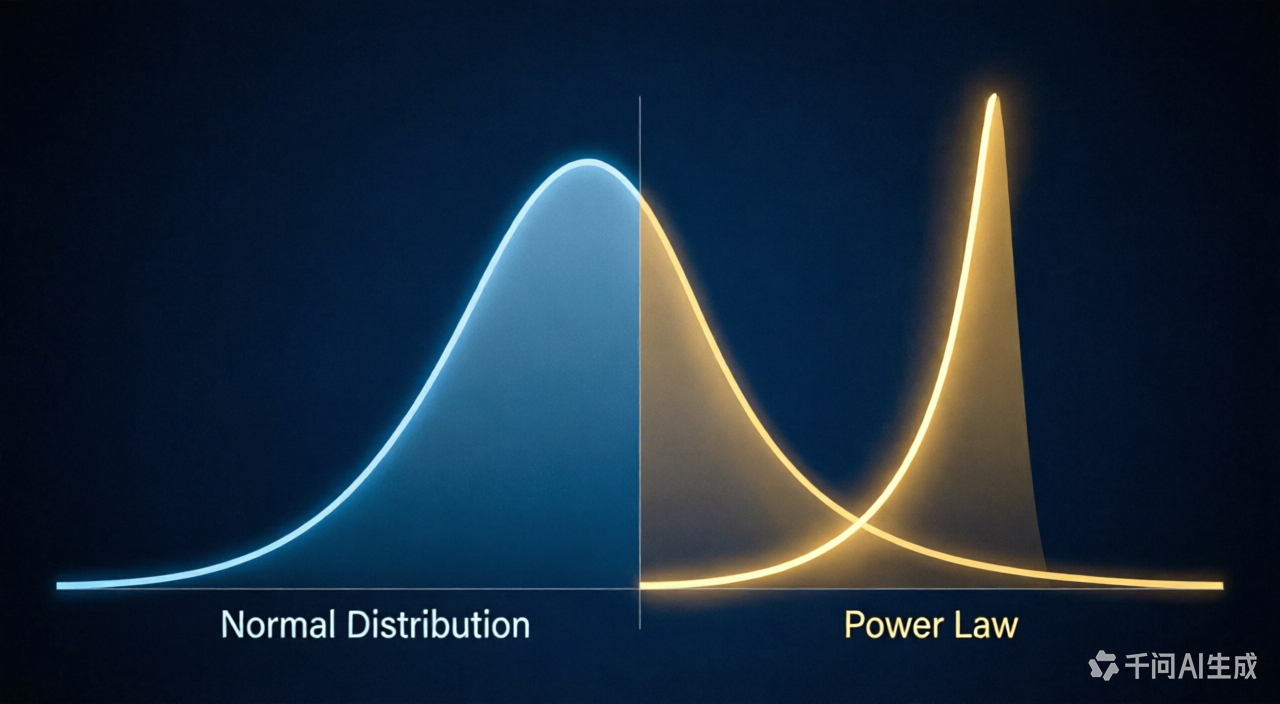
The world of wealth doesn’t follow normal distribution — it follows power law distribution.
- In a normal distribution world, effort matters — every additional word you memorize earns you another test point; effort and reward are roughly proportional
- In a power law world, the top 1% take 99% of the returns — here, position is the signal, effort is just noise
An engineer diligently working at a mature corporation versus an engineer holding early-stage stock options at a startup — both grinding 996 — five years later, the latter’s expected wealth could be tens or even hundreds of times the former’s. Is the gap effort? No. It’s their position — one stands on the flat tail of the power law curve, the other happened to be on the steep ascent.
The vast majority of people’s hard work essentially uses their time and life to contribute chips to the power-law game’s winners while continuously diluting their own opportunity cost.
So what’s the correct strategy? Not working harder, but finding a market earlier that hasn’t yet entered the power-law convergence phase. At that point, the competitive landscape is chaotic, rules aren’t fully established, and early players can still seize favorable positions through keen judgment and execution.
2012’s WeChat Official Accounts, 2016’s TikTok, 2020’s Video Accounts — every such window is a chance for the power-law curve to be redrawn.
But entering earlier means facing massive uncertainty alone. And in that chaos, what truly sets you apart isn’t diligence — it’s seeing a tiny but lethal information gap before anyone else.
3 | Information Asymmetry: The Most Stable Source of First Fortunes
In 1970, economist George Akerlof published a paper called “The Market for Lemons.” He studied the used car market and found a strange phenomenon:
Because buyers can’t tell which cars are good and which are lemons, they’ll only pay the average price. Good car owners find it unprofitable and exit the market, until only bad cars remain and the entire market collapses.
Akerlof won the Nobel Prize for this. His paper warned about the dangers of information asymmetry, but today I’m showing you the other side of the coin —
Information asymmetry is the most stable and dignified source of first fortunes.
I’m not talking about deception, but a more sophisticated play: cognitive time-lag arbitrage.
In 2015, a group of Chinese foreign trade practitioners stumbled upon a parallel universe — a high-end imported medical device retailed to US consumers at a price lower than the wholesale price Chinese distributors were paying.
Why? Because the US consumer market was fiercely competitive and manufacturers used low prices for market share, while China’s B2B market had sluggish information flow, with layers of agents marking up prices still based on pricing from years ago.
What these people did was extremely simple: go to the US, legally purchase like ordinary consumers, then ship back to China and sell to information-lagging distributors at domestic market prices. Nobody in the chain was harmed — sellers got genuine products, buyers got market prices. The only variable was that someone leveraged a years-long information time lag across the Pacific, neatly pocketing the spread.
This logic still plays out everywhere today:
- During the livestream e-commerce boom, some people didn’t produce anything — they specifically sought out factories with excellent quality but zero brand premium. Their profit was the cognitive gap between factory and consumer
- During the pandemic, those who could lock down overseas mask supplies early weren’t privileged — they were simply embedded in the foreign trade industry and could read the global supply chain’s reaction 72 critical hours faster than the domestic market
Your first fortune is likely hiding in the quote sheet where supply and demand information in your industry is extremely asymmetric.
But information gaps have one fatal weakness — time erodes them. When people flood into the same low point, it stops being low. This forces you to think: is there a more durable lever than information?
Yes. It’s your credit.

4 | Credit Expansion: Using Other People’s Money for Your Primitive Accumulation
In Chinese business circles, there’s a story about Wang Jianlin’s early days. The startup capital gap for his first major project was enormous. What did he do?
He didn’t rely on his own cash — he got the government to issue a document for him. With that document, he secured credit limits from banks far exceeding his actual net worth. That piece of paper was worth over ten times his entire fortune at the time. He used future credit to pry open a present-day entry ticket.
Behind this is a powerful economic theory — Signaling. In an information-asymmetric market, the high-quality party must send a credible signal to make the resource holder believe in them.
Education is a signal, past performance is a signal, industry endorsement is also a signal. But one type of signal has the lowest cost and highest utility —
Having an already-successful person vouch for your character and ability. The fastest path to the first fortune has never been saving money — it’s making those who control resources believe you’re worth investing in early.
This logic is everywhere in business, and its name is credit expansion:
- A restaurant entrepreneur, before his first store is even profitable, convinces his core supplier to give him 60-day payment terms — that’s using the supplier’s capital for free for two months
- A content creator, with just a few early high-quality pieces, gets a major brand to prepay a full year’s collaboration fee — that’s exchanging future traffic for today’s startup capital
How can ordinary people build this early credit? Three specific actions:
| Action | Specific Approach |
|---|---|
| Create outsized signals | Complete a project at your current position that far exceeds everyone’s expectations, making an influential person think “this person is different” |
| Make signals transferable | Get that person willing to recommend you to someone with more resources — trust transmission is where credit expansion begins |
| Trade in credit, not cash | In collaborations, prioritize delivering on promises with your professional ability in exchange for resources, rather than using limited cash |
You’ll find this creates a closed loop: use trick #3’s information gap to earn a small first sum; the sum itself doesn’t matter — what matters is this successful arbitrage becomes your first credit signal. You take that signal to leverage larger resources.
But here’s a secret no one willingly shares: historically, nearly every story of credit-expansion-driven primitive accumulation happened during a special period — a gray zone where others couldn’t understand and regulators hadn’t caught up.

5 | Regulatory Arbitrage: Staking Position in the Blank Spaces of Rules
Bezos knew one thing crystal clear when he founded Amazon in its first year:
US tax law had no clear provisions for cross-state online sales. This meant selling books online didn’t require paying sales tax like physical bookstores in most states. This tiny regulatory gap became one of his core early price advantages.
This behavior in institutional economics is called Regulatory Arbitrage — the core is exploiting gaps between different rule systems, or the vacuum where a single set of rules hasn’t yet reached, to complete market positioning ahead of time.
Looking back at the past decade, such stories are everywhere:
- The explosive growth of China’s internet finance from 2012 to 2015 happened largely because traditional financial regulation hadn’t yet covered internet lending. In that brief window, some accumulated fortunes while others who moved too slowly became the casualties when rules caught up
- Early food delivery platforms’ subsidy wars were essentially regulatory arbitrage — labor laws at the time were extremely vague about whether “platforms and riders have an employment or partnership relationship,” allowing platforms to rapidly expand operations at extremely low compliance costs
I’m not encouraging you to break the law. I’m stating an objective fact — regulatory perfection always lags behind business innovation, and this lag itself is a massive time window.
A practical observation method: watch for fields where the technology is already mature, but ethics and regulations are still being hotly debated.
- Copyright boundaries for AI-generated content are being redefined
- Low-altitude rules for drone delivery are just being drafted
- Commercial pathways for personal biological data remain unresolved
In every such blank space, a batch of smart people is quietly testing boundaries.
At this stage, you don’t face red-ocean competition — you face massive uncertainty. But uncertainty and risk are two different things — risk can be calculated and hedged; uncertainty cannot be quantified. But precisely because it can’t be quantified, uncertainty is where excess returns hide.
The vast majority will wait until rules are clear and everything is certain before entering — but that moment is also when excess returns completely vanish.

6 | Path Dependence: Making Money Is Just the Beginning of the Game
By this point you probably sense that acquiring the first fortune is more like a complete cognitive system than a stroke of luck.
But there’s one final question — the most deadly one: You made the money, then what?
In the 2015 Chinese stock market, a young investor used precise information gaps and decisive action to quickly accumulate tens of millions during the bull run. At the market’s most frenzied peak, he made a decision — max leverage, all in.
His reasoning was simple: over the past months, this high-risk, high-reward pattern had worked every time. He believed he’d cracked the market’s code.
We all know the outcome. In the unprecedented crash that followed, he not only lost all his capital but was buried under debts he could never repay.
This tragedy happened because two concepts compounded behind the scenes:
6.1 Path Dependence
However you earned your first fortune, you will instinctively — even unconsciously — use the same approach to manage and grow that money. If you succeeded by breaking rules, you’ll keep seeking the next rule to break, even when the market landscape has completely transformed.
6.2 Risk Preference Reset
Acquiring the first fortune requires extremely high risk tolerance, but preserving and passing on wealth requires extremely low risk tolerance. These two states demand almost diametrically opposite personality traits.
But the vast majority of people fail to make this critical personality switch. They think they’ve tamed risk, but the truth is — risk simply let them off temporarily.
How do you complete this switch? Three specific actions you can write down right now:
1. Actively downshift — Immediately after the first fortune arrives, move a substantial portion of assets into low-risk categories you’re completely unfamiliar with, maybe even look down on — like government bonds and basic index funds. This isn’t about returns — it’s about taming your pattern.
2. Build a failure-tolerance mechanism — Set a clear loss threshold for your remaining risk assets, say 20%. Once triggered, exit unconditionally — no discussion, no hesitation, no illusions. This mechanism must be set when your mind is cool and executed when your emotions are running hot.
3. Bring in a contrarian — Find an investment advisor or partner whose style is completely opposite to yours. Their sole purpose is to counteract your path dependence, raising the most rational objections when you’re most confident.
Bottom line:
Earning the first fortune requires tolerating uncertainty better than others; keeping the first fortune requires tolerating boring certainty better than others.
These two abilities rarely coexist in the same person. But knowing this fact alone has already given you a layer of cognitive armor that 99% of people don’t have.

7 | Connecting All Six Truths: A Real Wealth Operating System
Now let’s string today’s six knowledge points together, and you’ll see a clear thread:
The foundation of the first fortune was never a question about money — it’s a question about cognition.
- Rent-seeking theory tells you — go to the nodes where value flows, not the production floor
- Power law distribution tells you — choosing the right position outweighs effort in the wrong position
- Information asymmetry tells you — cognitive time lag itself is a monetizable intangible asset
- Credit expansion tells you — credit is a more powerful lever than capital
- Regulatory arbitrage tells you — every rule update opens a briefly available window for money
- Path dependence tells you — earning money’s endpoint isn’t celebration, but a complete break from your past self
These rules constitute a real, sober, even somewhat brutal wealth operating system.
Now I’d like you to take away a deeper question:
In your current industry, in your daily life — what value is quietly flowing? Is your current position at the source, midway, or at the end of that flow? Could you perhaps take just one small step and stand beside that river?
This isn’t an easy truth — because it means those who work day after day without breaking through might not lack effort, but are navigating a changed continent with an old map.
But this truth also has a liberating side:
Once rules are seen clearly, they stop being fate. Once the invisible hand is “seen” by you, it transforms from your master into your opponent in the game.
Every wealth map restructuring in human history was accompanied by a small group who first decoded the new rules of the game.
Today that window is still open. The question was never whether opportunity exists — it’s whether you’re waiting for the old book full of answers, or you’ve already started writing that rulebook no one else has.
This article compiles insights from classic economic theories and real business cases. It is intended for wealth cognition inspiration only and does not constitute specific investment advice. Markets carry risk — please exercise caution and make independent judgments based on your own circumstances.
Comments