The Moment You Press BUY, Someone Is Doomed to Lose: Why Retail Traders Are Always the Lambs to the Slaughter
Are you staring at your phone right now, watching those red and green numbers flicker while your heart jumps up and down with them?
Have you ever asked yourself a question—one that might send a chill down your spine?
When your brokerage account is up NT$10,000 today, where did that NT$10,000 actually come from?
Every dollar you make—every single dollar—has been pulled, cent by cent, out of someone else’s pocket. The person losing money might be using the same phone model as you, checking the market at the very same moment, just as convinced that he is the smarter one.
“Buy low, sell high” sounds so simple it’s almost a cliché—any retiree playing chess in the park will tell you that. But the truth is: the instant you press that red BUY button, somewhere in the world there is a person, on the other end of a screen, pressing the green SELL button within the same millisecond.

You think you’re trading a stock, a ticker symbol, with this person? No. You are gambling against them—betting that your forecast of the future is more accurate, that your information is more complete, that your greed and fear are better controlled than theirs.
On a battlefield where information, capital, and even opportunity are crushed by layers of structural advantage, why on earth would you be the one who wins?
Today we’re not going to talk about the theories that put you to sleep, and don’t buy into the chicken soup that says “good mindset makes you money.” Let me take you on a god’s-eye tour—we’ll fly above this enormous casino called the market, and through a few brutally true stories, we’ll tear this veil apart.
The Money You Can Make in the Market Only Comes From Three Pockets
More than 90% of people, from the moment of their very first trade, are looking in the wrong pocket—and they don’t even know they’re the ones delivering the money.
The first pocket is called value creation. It is the cleanest, the most solid, and the slowest money—so slow it makes you question your life choices.
The second pocket is emotional speculation. This money flows the fastest and is the most dangerous. It is not the creation of value—it is the trading of human nature.
The third pocket is risk compensation—you agree to take on risks that others won’t, and the market pays you a fee for your trouble.
Let’s tear them apart one by one.
Pocket One: Value Creation — The Slowest but Most Solid Money
Imagine this: instead of trading stocks, you open a noodle shop downstairs. Last year, with a secret recipe and brutal early-morning shifts, you made NT$100,000. This year, you improved the flavor, added delivery, the business exploded, and you made NT$200,000. Did you抢 that extra NT$100,000 from someone else’s pocket?
No. You created new value with better service, customers paid willingly, and you earned what you deserve.
Scale that noodle shop up 10,000 times and you get a publicly listed company. It earned NT$100 million last year, NT$200 million this year. That extra NT$100 million is the incremental wealth it created for society. As a small shareholder, you get to take your share of that meat with a clear conscience.

To make this kind of money, you don’t need to know some technical wizard, you don’t need to read fancy candlestick charts, and you certainly don’t need to guess whether the market will be sunny or rainy tomorrow. It all comes down to one thing—is this company a real machine that keeps printing profits?
Take Novo Nordisk, the maker of insulin and weight-loss drugs. If you had told people ten or so years ago that you owned this stock, they would have looked at you with pity, thinking you’d bought into a boring “old-age disease” story with zero imagination. But for those ten years, the company was like a farmer quietly tending his fields, selling medicine around the world. Then one day it grew a golden seed—a weight-loss miracle drug called semaglutide. Suddenly, every overweight person on the planet went crazy for it.
Its profits didn’t just climb; they exploded. The people who had held its stock for a decade—because they understood the simple logic that “it solves a problem for humanity”—made money as the company’s intrinsic value expanded. How solid is this kind of money? It’s so solid that you can close the app, go travel, go fishing, and come back years later to find your wealth snowball rolling on its own.
The core idea is sharing—you are not gambling against someone else; you are sharing the growth dividend of an outstanding company.
But here’s the problem:
- Out of 1,000 companies, how many are like this?
- Even if you find one, it might spend ten years going nowhere. Do you have the patience to wait for an uncertain value explosion?
When your friends are all chasing the latest hot sector—metaverse today, AI tomorrow—and making a killing, will you feel like a fool for sitting on your steady plodder?
If I gave you two choices:
- A: Hold a boring stock compounding at 15% a year for ten years
- B: Chase a hot theme that might double or might get cut in half
What’s your first instinct? Probably B. Human nature loves shortcuts. So the vast majority of people rush toward the second pocket.
Pocket Two: Emotional Speculation — Fast Money, Bloody Money
The thing is the same thing. The company is the same company. But its price swings like a roller coaster, driven by human greed and fear.
“Be fearful when others are greedy, and greedy when others are fearful”—you’ve heard this a thousand times, and you’ve probably even adopted it as your motto. But it hides a fatal trap: what makes you so sure that the “other person” being treated as the fool isn’t you?
Let’s rewind to March 2020. COVID hit like a tsunami, global markets collapsed, and every day your account shrank. The feeling was like being slowly dismembered.
Let me show you two sets of data:
- Set 1: During those two most panicked weeks, a hedge fund called Citadel went against the tide and aggressively bought airline, hotel, and cruise-line stocks—the very “bankruptcy plays” everyone else was running from.
- Set 2: In those same two weeks, retail investors around the world set a record for net selling of those stocks. Their reason for selling was simple and unanimous: “The world is ending. These companies are definitely going under.”
What happened three months later? As central banks around the world flooded the system with liquidity, those very stocks the retail crowd had treated as garbage violently rebounded 60%, 70%, sometimes more.
See? This was a textbook-perfect bottom-fish. The blood-soaked chips that the institutions greedily scooped up were exactly the ones that countless ordinary people, just like you and me, had panic-sold at the worst possible moment.
What does it really mean to make money in this pocket? It means gaming—playing the counterparty’s bet against the human weaknesses of the vast majority. Your opponent is no mysterious whale; it’s your neighbor next door, your friends on social media, the millions of sheeple being pushed around by emotion.
- You think you’re “catching a bargain” when the price crashes? In reality, your amygdala is dumping cortisol, and your body is screaming “Run! Danger!” You are the person who, unable to bear the fear, is panic-selling cheap.
- You think you’re “riding the rally” when the price spikes? In reality, your dopamine has you hooked, you’re terrified of missing out on a fortune. You are the bag-holder, charging up the mountain because of greed.
The money in this pocket is seductive because it’s fast—buy today, you might hit the limit-up tomorrow. But it is also brutally bloody: every cent you make comes out of someone else’s fear and regret, and every cent you lose feeds someone else’s greed and composure.
It’s a giant slaughterhouse of human nature, and most people walk in holding the knife, only to end up as the sacrifice.
Pocket Three: Risk Compensation — The Most Hidden, the Most Professional
You agree to take on risks others won’t, and the market pays you a fee. Sounds abstract? Let me make it concrete.
That’s the entire logic of the insurance business. Why do you pay a few thousand dollars a year for car insurance? Because you dread one big accident wiping you out for tens of thousands. You pay to transfer the risk of a small-probability, large-loss event to the insurer. The insurer, on the other hand, collects premiums from 10,000 people like you. As long as no catastrophic disaster hits, the total payout永远 remains less than the total premiums collected. What it earns is compensation for bearing your risk.
In investing, the same logic applies.
In 2016, the global shipping industry fell into a deep winter. Hanjin Shipping, South Korea’s biggest shipping line, suddenly went bankrupt, and the domino effect began. Fear spread through the entire industry. Bond prices of every shipping company started tumbling. One company’s bonds were trading at just 30% of face value—you could buy NT$100 of bonds for NT$30.
Why? Because the market thought it might be the next Hanjin, on the verge of death.
At that point, a distressed-debt fund entered the scene. They didn’t try to predict when shipping would recover. They did something tedious: they sent people to major ports around the world to count this company’s ships one by one, evaluating the value of every vessel and every shipping route.
They ran the numbers. Even if the company went bankrupt right now and liquidated everything—every ship sold off—the assets they could liquidate were still worth 50% of the bond’s face value.
What did that mean? At a purchase price of 30, even in the worst case—bankruptcy—they would get back 50. That is a risk-free trade; the only question was how much they would make. If the company survived, they’d get the full 100 plus high-coupon interest.

This is making money from risk compensation. What you’re earning isn’t the result of correctly predicting that the company will rise from the dead. What you’re earning is that everyone in the market, in their panic, mispriced the risk, and you, through professional research, found that mispricing and had the guts to bet on it.
The Cruelest Truth: You Think You’re in Pocket One or Three, but You Haven’t Even Made It Into Pocket Two
These three pockets look like highways to Rome—value investing to share growth, emotional speculation to buy low and sell high, risk compensation to crunch the numbers with precision.
But the cruelest truth is this: the vast majority of ordinary people think they’re aiming for Pocket One (“I’m doing value investing”) or Pocket Three (“I’m going for high risk, high return”)—but in reality, they haven’t even made it through the door of Pocket Two, emotional speculation.
There’s an unwritten rule in the financial world, an old saying from the poker table: “If ten minutes into the game you still haven’t figured out who the worst player at the table is, then the worst player is almost certainly you.”
Do you remember the 2021 GameStop short squeeze—the epic battle of retail vs. Wall Street? A group of self-proclaimed “dumb money” retail traders rallied on Reddit, took a near-delisted, heavily-shorted trash stock from about $15 all the way to over $400. The media spun it as a热血 story of “ants toppling elephants, retail united against the sickle”—millions were moved to tears, believing they were witnessing history.
But when the dust settled, the cold data revealed the flip side of that热血 fairy tale. On the wildest trading days with the highest volume, who actually booked astronomical profits? Apart from a handful of early ringleaders who had潜入 early, it was high-frequency trading firms and market makers—Citadel, the one we mentioned earlier, and a firm called Virtu.
Did these people care about retail justice? No. They didn’t care about anything except one thing: the spread. When tens of thousands of retail traders flooded the trading app like a tidal wave, frantically tapping BUY, these HFT firms slipped between your buy and sell orders at millisecond or even microsecond speed to collect the spread: your buy order at $400.10, their sell order at $400.08—they pocketed that $0.02 difference in nanoseconds. Each fill earned them a tiny two cents, but with turnover in the tens of millions, even hundreds of millions of shares a day…

In the end, the glorious retail revolution was over, leaving a trail of wreckage. The HFT firms’ quarterly profits hit record highs.
You see, you think you’re investing, fighting, rewriting history. But in the eyes of the real professional players, every emotion-driven click of buy or sell, every ounce of your self-righteous justice, is itself the source of their profits.
This isn’t a conspiracy theory—it’s an open business model. In the US, there’s something called Payment for Order Flow (PFOF). Why are the zero-commission trading apps you use free? Because they bundle your orders and sell them to HFT firms like Citadel. In 2022 alone, that business alone brought in over US$3 billion in profit for the market makers. Where did that money come from? It came from every single trade friction you thought was free.
You think you’re trading for free on an app. In reality, your trading behavior is the product being sold.
The information gap is an even wider moat. When you see a flash news alert on your finance app that a company just beat earnings expectations, what do you feel? Excited, rush to buy. But what you don’t know is that top-tier investment firms spend tens of millions of dollars a year on commercial satellite imagery, counting cars in mall parking lots to predict quarterly revenue; they track global credit-card spending data to gauge consumer trends; they monitor global supply-chain logistics to know next quarter’s raw-material costs before the company CEO does.
By the time that good-news alert pops up on your phone, the institutions with the “information radar” may have already finished positioning themselves hours or even days earlier. The price you see when you rush in is the price where they’ve already eaten the fattest cut of meat and are picking their teeth as they head for the exit.
Information asymmetry, speed asymmetry, capital asymmetry—on this battlefield, a retail trader who relies on news headlines, gut feelings, predictions, and frequent trading going head-to-head against these armed-to-the-teeth elite special forces, the outcome was sealed the moment you pressed “Open Account.”
The Retail Trader’s Real Ace: Not Faster, but Slower
Does this feel hopeless? Like ordinary people are just lambs lined up for slaughter?
But that absolutely does not mean the retail trader has zero chance. Quite the opposite—every one of us, the small retail trader, is actually holding an ace. An ace that makes every fund manager envious enough to drool. The irony is that the majority of retail traders are throwing that ace straight into the trash.
That ace is time.
When I say “time,” I don’t mean the kind of correct-sounding fluff about “you should hold long-term.” I mean a structural, dimensionality-reducing advantage.
Imagine a top global fund manager—let’s call him Mr. Zhang. He controls trillions in capital, and behind him are countless clients watching his performance. Every quarter he has to deliver homework. Underperform the market two quarters in a row, and big clients start redeeming capital—his bonus is gone. Underperform four quarters in a row, and he might be packing his desk.
So tell me—even if Mr. Zhang is 100% certain that a stock will 5x in three years, but it might drop 30% in the next two quarters because of industry adjustment, would he dare to go all in? Absolutely not. He can’t wait. His clients can’t wait. His boss can’t wait. His career can’t wait. The rules of his game don’t allow him to absorb huge short-term volatility and drawdowns, even if he knows it’s temporary.
This is your opportunity.
In the 2008 financial crisis, the Harvard University endowment—wealthy beyond imagination—faced extreme cash-flow pressure from the tsunami. It was forced to sell off some of the high-quality private-equity assets it held, at less than half their value, at fire-sale prices. Did it want to sell? No. But it had no choice. It needed cash. It couldn’t wait.
Who picked up those blood-soaked but immensely valuable chips? Not larger institutions, but some quietly-wealthy family offices and visionary individual investors. They had no quarterly performance review pressure, and the money in their hands could wait. Five years later, those assets had not only fully recovered, some had tripled or quintupled in value.

What kind of money did they make? They made the money of “I can wait, and you can’t.” They made the money that exploits the time anxiety of professional institutions.
The greatest advantage of us ordinary retail traders is precisely the freedom not to be forced to sell at the worst possible moment. When all the professional players are forced—by client redemptions, by risk-control lines—to collectively dump their positions at the most panicked, cheapest moment, you can sit there quietly, even calmly use spare cash to scoop up the gold they’ve thrown on the ground. That alone is a dimensionality-reducing strike.
What a pity so many people voluntarily swap this time advantage for a disadvantage. How? Two words: overtrading.
Two professors at National Taiwan University ran a 15-year study tracking tens of thousands of retail trading records. The result was heartbreaking: the 20% of traders who traded most frequently had an annualized return a full six percentage points lower than those who bought an index fund and then just lay flat.
What does six percentage points mean? With NT$1 million in capital, those most diligent traders earned NT$60,000 less per year than the most “lazy” investors. Not because they picked bad stocks, but because every one of those buys and sells you thought was so smooth was paying commission and stamp duty—friction costs. More importantly, every time you traded, you were voluntarily giving up your time ace, jumping into the meat grinder of HFT and information asymmetry, sprinting the 100-meter dash against professional short-distance runners. You, an amateur marathon runner, took a race that should have been yours—a marathon—and forced it into a series of 100-meter sprints you were destined to lose.
So the smartest strategy for an ordinary person in the market is to actively use your time-insensitivity to fight the time-anxiety of institutions. When you don’t have to trade just because next month’s mortgage is due, or because next quarter’s performance review is here, you’ve already won at the starting line.
Expected Value Thinking: Drop the Naive Fantasy of “I Must Be Right This Time”
But if you push this logic one layer deeper, you’ll hit a more fundamental and uncomfortable truth—most of us grossly overestimate our own judgment.
We always assume that making money in investing requires divination, precisely predicting tomorrow’s hot sector, identifying the next Maotai. But if you look at the people who have actually built huge wealth through investing—Buffett, Soros, Howard Marks—you’ll find a counter-intuitive commonality: they almost never make precise predictions.
Howard Marks, founder of Oaktree Capital, manages nearly US$200 billion. He has a famous quote that’s practically scripture in the investing world: “We don’t try to predict the future. We only assess the present—whether the odds we’re betting on are good enough.”
That sentence exposes the most底层 mental model for making money in investing—expected value thinking.
What’s that? Don’t be scared, it’s not complicated at all. You don’t need to know for sure that something will happen. You only need to assess three things:
- If it happens and you’re right, how much can you make?
- If it doesn’t happen and you’re wrong, how much will you lose?
- What’s the approximate probability of it happening?
Then do an elementary-school math problem:
Win Amount × Probability of Winning − Loss Amount × Probability of Loss = Expected Value
As long as the result is positive, even if the probability isn’t that high, it’s still worth betting on. Because over the long run, it will make you money.
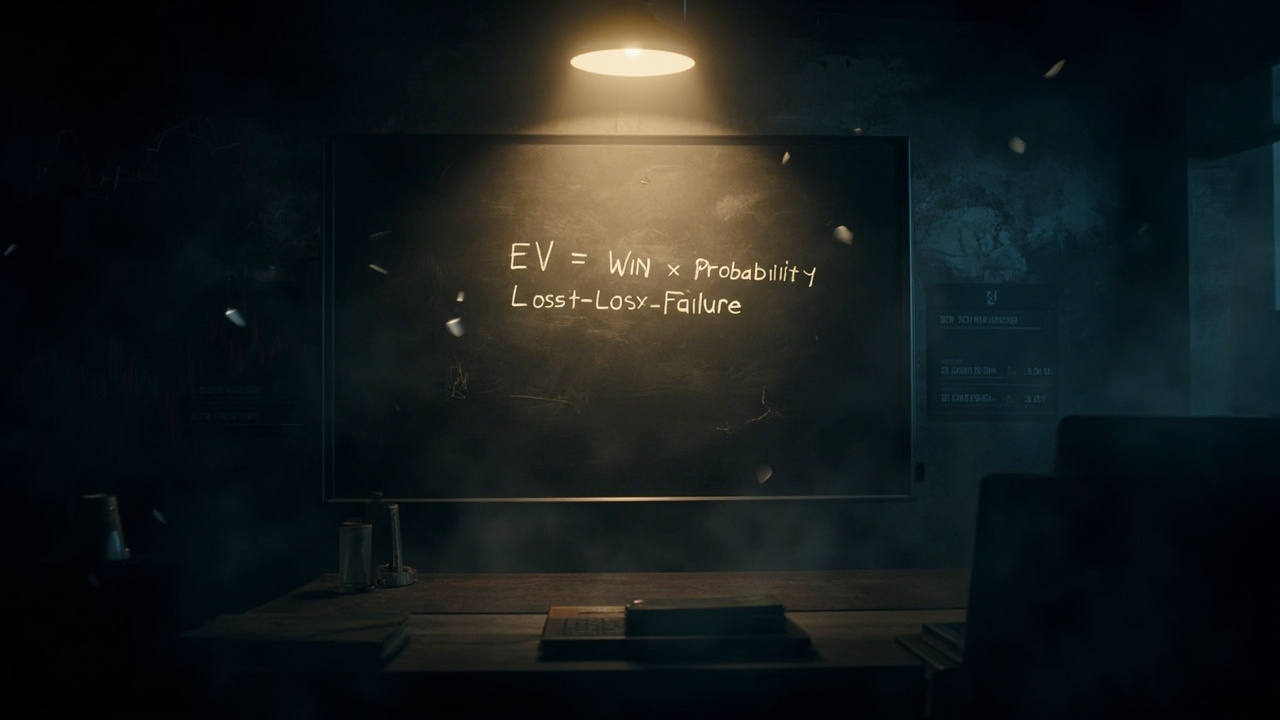
Example: Before the 2016 Brexit referendum, the global mainstream media, experts, and scholars all believed the UK would not leave the EU. But some敏锐 hedge funds noticed that the bookmakers’ odds for Brexit were 1-to-4—bet 1, get 5 back (including your stake) if you won. That meant the market thought the probability of Brexit was below 20%.
But these funds, through their own analysis and polls, thought the real probability of Brexit might be as high as 35%. Let’s do the math:
- Expected Value = (Win 4 × 35% probability) − (Lose 1 × 65% probability)
- = 1.4 − 0.65 = 0.75
Positive. So they quietly placed their bets. The UK actually did leave. Global markets were rocked. They made a killing.
But the most关键 part is this: even if the UK had ultimately not left, the decision to bet, from a mathematical standpoint, would still have been correct. Because they were making money from the spread in probability, not from being right about the prediction.
The same logic applies in life. Imagine two opportunities in front of you:
- Opportunity A: You’re 80% confident of making NT$100,000
- Opportunity B: You’re only 20% confident, but if you succeed you make NT$2 million
Many people will instinctively choose A because it’s “safe.” But let’s do the math:
- Expected Value of A = NT$100,000 × 80% = NT$80,000
- Expected Value of B = NT$2 million × 20% = NT$400,000
The rational choice is B, on the condition that you can afford the 80% chance of failure—that one loss won’t knock you out of the game for good.
This brings us to the most important companion to expected value thinking—position sizing. In plain language: never put all your hope and capital on one or two trades you think are brilliantly predicted. The real master finds many B-like opportunities with positive expected value, and only commits a small slice of capital to each one. You might lose on a single trade, even lose several in a row, but as long as you play enough times, the law of large numbers will be on your side, guaranteeing you end up a winner.
The masters of investing have never been fortune-tellers who can count the future on their fingers—they are cool-headed probability gamblers, cold-blooded risk accountants. They don’t追求 winning every round; they make sure that over the long run, the total ledger is positive.
Back to the Beginning: How Do You Actually Make Money in Investing?
Let’s summarize, three steps:
- See clearly which pocket the money you want to make comes from—is it value creation, sharing in a company’s growth; emotional speculation, gaming the market’s emotions; or risk compensation, getting paid for taking on uncertainty? Choose the wrong battlefield, and all your efforts are just delivering money to others.
- Use your time-freedom ace to the hilt—don’t use your amateur hobby to challenge other people’s livelihood, where millisecond reactions are essential. Use your “slowness” to fight their “speed.”
- Drop the naive fantasy of perfect prediction, and embrace the scientific mindset of expected value—transform from a gambler who says “I have to be right this time” into an operator who says “over the long run, I will大概率 win.”
But what I want to say in the end is that underneath all of this, at the very bottom—the logic of investing and the logic of making money in life are strikingly similar:
You can never sustainably hold wealth that exceeds the boundaries of your cognition.
The market is like a brutally honest放大镜. What it magnifies is not your capital, but your cognitive structure, your personality flaws, the deepest desires and fears hidden inside you.
- You fear, and it oscillates at the bottom, forcing you to panic-sell before dawn.
- You are greedy, and it manufactures frenzy at the top, making you catch the last棒.
- You think you’re rational, and it uses a string of rallies to destroy your faith, making you throw your value-investing books into the trash.
So investing, on the surface, is a financial game about money—but at its core, it’s a修行 of a lifetime battle between each of us and our own human nature.
How honest are you with your own weaknesses? When the whole world is partying, can you stay silent and think independently? When the market is dead silent and no one dares touch it, can you be the one to step up and place a bet? These questions have no standard answer in any textbook.
The answer lies in that primitive impulse to buy or sell that wells up in your chest every time your account ticks—beat it, and you might become the one taking money from other people’s pockets; let it beat you, and you’ll be the one quietly paying for other people’s cognition.
The market was never the hard part. The hard part is recognizing the person looking back from the mirror.
This article reflects the author’s personal views and does not constitute any investment advice. Investing involves risk; please decide carefully.
Comments